Pulaski County Dog Registration Information
Service Dogs and Emotional Support Animals in Pulaski, Indiana
If you’re searching where do I register my dog in Pulaski County, Indiana for my service dog or emotional support dog, the key point is this: a dog’s local registration or license (when required) is separate from a dog’s service dog legal status or an emotional support animal (ESA) designation. In Pulaski County, most “registration” questions connect to rabies vaccination compliance, local animal control enforcement, and any local dog license rules administered by a county or town office.
Overview of Dog Licensing in Pulaski County, Indiana
What “dog registration” usually means in Pulaski County
People often use the phrase “register my dog” to mean one of the following:
- Getting a dog license in Pulaski County, Indiana (if your city/town or county has a licensing requirement).
- Confirming your dog’s rabies vaccination is current and having proof available if requested by local officials.
- Contacting animal control for help with stray dogs, bites, quarantine rules, or enforcement—sometimes searched as animal control dog license Pulaski County, Indiana.
- Understanding whether a service dog or emotional support animal changes any local licensing rules (typically: it does not eliminate basic public health requirements like rabies vaccination).
Rabies enforcement and bite reporting (public health)
Rabies prevention and bite investigations in Indiana involve local health departments. Indiana’s rabies guidance explains that animal bites to people are handled through local health officials, and state rules include a 10-day observation period for dogs, cats, or ferrets involved in a bite (as directed by the local health officer). (in.gov)
Bottom line: even if you’re focused on where to register a dog in Pulaski County, Indiana, you should expect questions about rabies vaccination proof and compliance if there’s an incident, complaint, or licensing application.
Where to Register or License Your Dog in Pulaski County, Indiana
Because licensing and enforcement are often handled locally, these are examples of official offices in Pulaski County that residents commonly contact for local rules, animal control direction, rabies-related questions, and government-issued records. If you are unsure which office issues a dog license (if applicable in your area), start with the Sheriff’s Office (animal control/law enforcement) and the Health Department (rabies/public health), then ask whether the county or your town uses a specific licensing point of contact.
Pulaski County Health Department
- Address
- 125 S Riverside Drive, Room 205
- City/State/ZIP
- Winamac, IN 46996
- Phone
- (574) 946-6080
- Hours
- Not listed on the cited contact page
Pulaski County Sheriff’s Office
- Address
- 110 E Meridian Street
- City/State/ZIP
- Winamac, IN 46996
- Phone
- (574) 946-6655
- Not listed as a general contact email on the cited office page
Pulaski County Clerk of Courts (Circuit Court Clerk)
- Address
- 112 E Main Street, Room 018
- City/State/ZIP
- Winamac, IN 46996
- Phone
- (574) 946-3313
- clerksoffice@pulaskicounty.in.gov
- Hours
- Mon–Fri, 8:00 am – 4:00 pm ET
Pulaski County Treasurer (County Government)
- Address
- 112 E Main Street
- City/State/ZIP
- Winamac, IN 46996
- Phone
- (574) 946-3632
- Not listed in the cited official treasurer page snippet
How Dog Licensing Works Locally in Pulaski County, Indiana
1) Start with your address (county vs. town rules)
“Where to register a dog in Pulaski County, Indiana” can depend on whether you are in an incorporated town/city or in unincorporated county areas. Local governments often control licensing and animal ordinances, while public health rules (like bite reporting and quarantine guidance) run through the local health department and state public health regulations. (in.gov)
2) Expect to show rabies vaccination proof
Even when a local dog license is required, the most common documentation asked for is proof of current rabies vaccination. Indiana guidance emphasizes rabies prevention and local health department involvement after exposures, and state rules describe the investigation and observation process for biting animals. (in.gov)
3) If there is no dedicated animal control office, law enforcement may handle it
Indiana’s animal care and welfare guidance explains that enforcement for companion animal neglect/abuse falls to local animal control or law enforcement, and if a county/city does not have an animal control agency, residents should contact local law enforcement through the sheriff’s department. (in.gov)
4) What to ask when you call
To get a clear answer quickly, ask:
- “Do I need a dog license in Pulaski County, Indiana for my address, or is it handled by my town?”
- “Which office issues the license and collects the fee (if any)?”
- “What documents are required—rabies certificate, proof of residency, photo ID, etc.?”
- “If my dog is a service dog or ESA, does that change anything about local licensing?” (Usually: licensing requirements still apply.)
Service Dog Laws in Pulaski County, Indiana
Service dog status is not the same as a local dog license
A service dog is generally a dog trained to do specific work or tasks for a person with a disability. This is a legal status tied to disability law and training, not a county “registration” product. In other words, you do not need to purchase a “service dog license” from a third party to have a legitimate service dog.
Does a service dog still need rabies vaccination and local compliance?
Yes. Service dogs are still dogs, and public health rules like rabies prevention, bite reporting, and quarantine requirements can still apply. Indiana’s rabies guidance and state regulations describe how bites are investigated and how observation/quarantine may be ordered by local health officials. (in.gov)
Practical takeaway for “registering” a service dog
If your goal is to be fully prepared in Pulaski County: keep your dog’s rabies vaccination current, keep documentation accessible, and follow any locally applicable licensing rules. If you need the correct local point of contact, the Sheriff’s Office and Health Department are the most direct starting points. (pulaskionline.org)
Emotional Support Animal Rules in Pulaski County, Indiana
An ESA is not a service dog
An emotional support animal (ESA) provides comfort through its presence, but it is not trained to perform specific tasks the way a service dog is. As a result, ESA status does not automatically grant the same public-access rights as a service dog.
ESA status does not replace local licensing or rabies requirements
If your area requires a dog license, your ESA typically still needs to meet the same local rules as other dogs, including rabies vaccination proof and compliance if there is a bite/exposure incident. Indiana’s rabies program materials and state rules describe local health department involvement and bite control measures. (in.gov)
Avoid third-party “ESA registration” sites
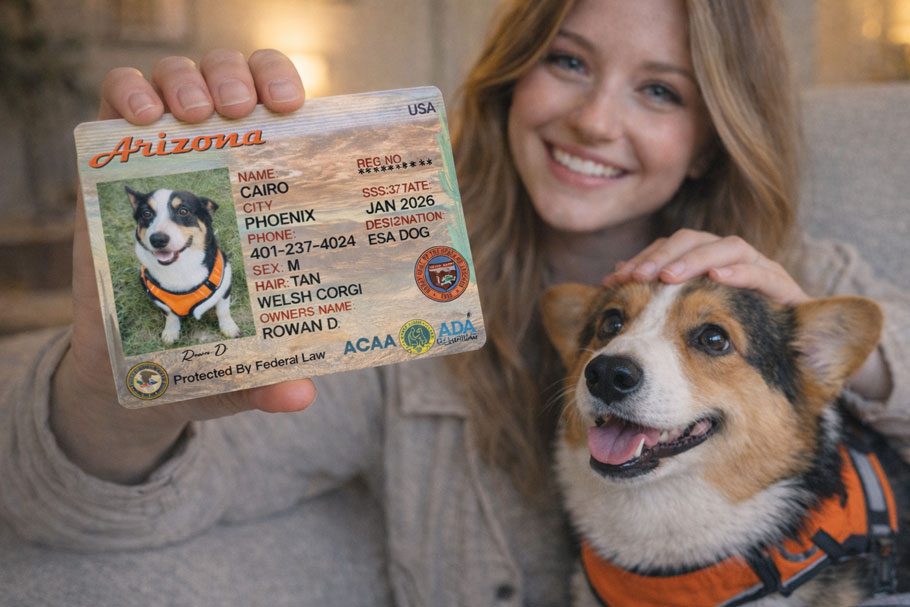
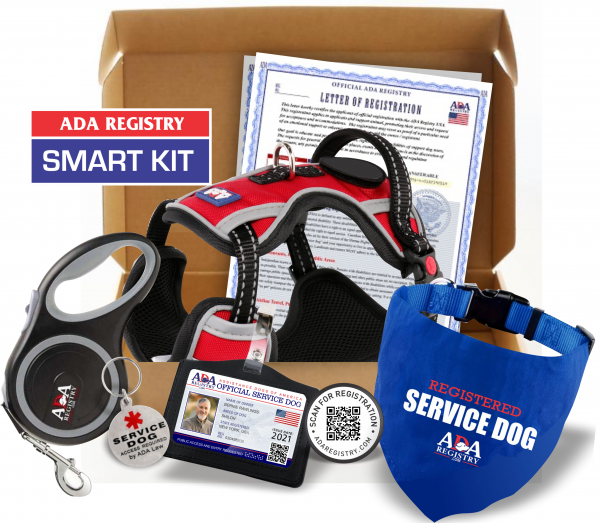
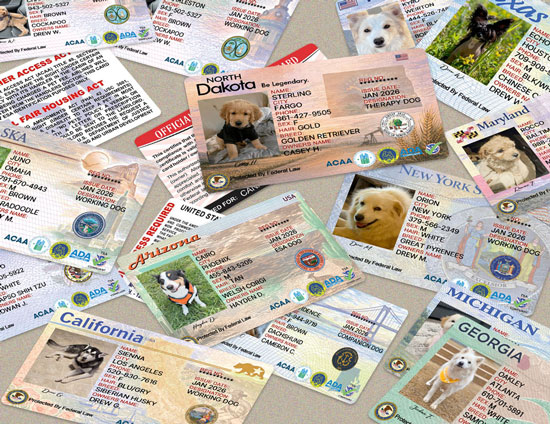
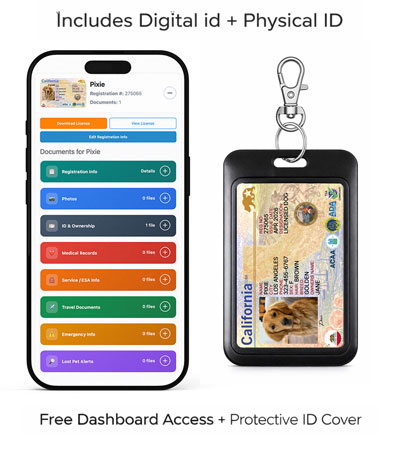
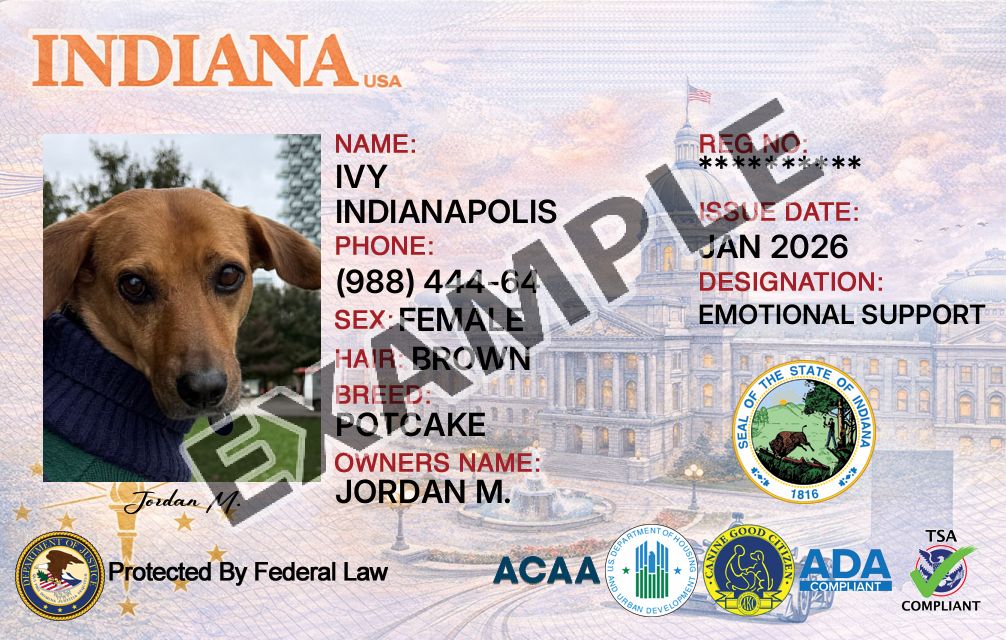
Many websites sell certificates, ID cards, or registries. Those are not government-issued dog licenses and generally do not change local licensing requirements. If you want the official answer for Pulaski County, contact the offices listed above and ask specifically about your address and local ordinances.
Frequently Asked Questions
Disclaimer: Licensing requirements and office locations may change. Residents should verify details with their local animal services office within Pulaski County, Indiana.
Register A Dog In Other Indiana Counties
Select your county below to get started with your dog’s ID card. Requirements and license designs may vary by county, so choose your location to see the correct options and complete your pup’s registration.
- Adams County Dog Registration
- Allen County Dog Registration
- Bartholomew County Dog Registration
- Benton County Dog Registration
- Blackford County Dog Registration
- Boone County Dog Registration
- Brown County Dog Registration
- Carroll County Dog Registration
- Cass County Dog Registration
- Clark County Dog Registration
- Clay County Dog Registration
- Clinton County Dog Registration
- Crawford County Dog Registration
- Daviess County Dog Registration
- Dearborn County Dog Registration
- Decatur County Dog Registration
- DeKalb County Dog Registration
- Delaware County Dog Registration
- Dubois County Dog Registration
- Elkhart County Dog Registration
- Fayette County Dog Registration
- Floyd County Dog Registration
- Fountain County Dog Registration
- Franklin County Dog Registration
- Fulton County Dog Registration
- Gibson County Dog Registration
- Grant County Dog Registration
- Greene County Dog Registration
- Hamilton County Dog Registration
- Hancock County Dog Registration
- Harrison County Dog Registration
- Hendricks County Dog Registration
- Henry County Dog Registration
- Howard County Dog Registration
- Huntington County Dog Registration
- Jackson County Dog Registration
- Jasper County Dog Registration
- Jay County Dog Registration
- Jefferson County Dog Registration
- Jennings County Dog Registration
- Johnson County Dog Registration
- Knox County Dog Registration
- Kosciusko County Dog Registration
- LaGrange County Dog Registration
- Lake County Dog Registration
- LaPorte County Dog Registration
- Lawrence County Dog Registration
- Madison County Dog Registration
- Marion County Dog Registration
- Marshall County Dog Registration
- Martin County Dog Registration
- Miami County Dog Registration
- Monroe County Dog Registration
- Montgomery County Dog Registration
- Morgan County Dog Registration
- Newton County Dog Registration
- Noble County Dog Registration
- Ohio County Dog Registration
- Orange County Dog Registration
- Owen County Dog Registration
- Parke County Dog Registration
- Perry County Dog Registration
- Pike County Dog Registration
- Porter County Dog Registration
- Posey County Dog Registration
- Putnam County Dog Registration
- Randolph County Dog Registration
- Ripley County Dog Registration
- Rush County Dog Registration
- Scott County Dog Registration
- Shelby County Dog Registration
- Spencer County Dog Registration
- St. Joseph County Dog Registration
- Starke County Dog Registration
- Stueben County Dog Registration
- Sullivan County Dog Registration
- Switzerland County Dog Registration
- Tippecanoe County Dog Registration
- Tipton County Dog Registration
- Union County Dog Registration
- Vanderburgh County Dog Registration
- Vermillion County Dog Registration
- Vigo County Dog Registration
- Wabash County Dog Registration
- Warren County Dog Registration
- Warrick County Dog Registration
- Washington County Dog Registration
- Wayne County Dog Registration
- Wells County Dog Registration
- White County Dog Registration
- Whitley County Dog Registration